Sunday, 14 February 2010

Collection 100 part 1, 2 and 3


'Process is more important than outcome'

Ideas generation:

15 objects I find interesting:
  1. Patterned fabrics
  2. ribbon
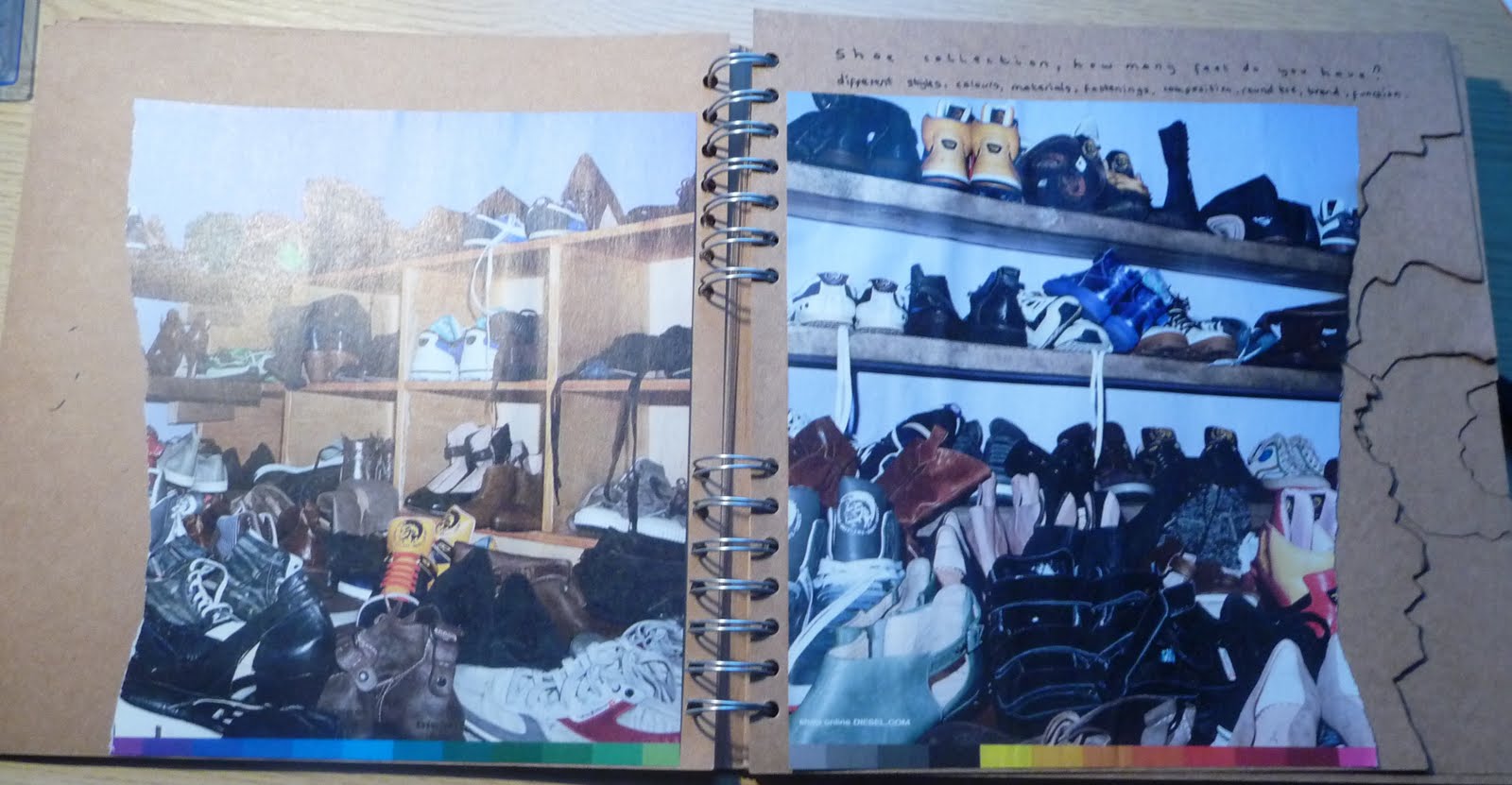
  3. shoes
  4. pens
  5. photos
  6. lights
  7. notebooks
  8. apples
  9. vintage objects
  10. t-shirts
  11. books
  12. boxes
  13. money
  14. puzzles
  15. buttons.
15 subjects I find interesting:
  1. Crafts
  2. fashion
  3. photography
  4. extraordinary people
  5. culture
  6. music
  7. interior decoration
  8. the universe
  9. crime
  10. celebrities
  11. graphic design
  12. philosophy
  13. overheard conversations
  14. fashion illustration
  15. travel.
15 places/environments that I find interesting:
  1. Space
  2. remote places - desert/jungle
  3. jails
  4. eiffel tower
  5. Madame Tussauds
  6. theme parks
  7. car parks
  8. ocean
  9. Grand Canyon
  10. Hollywood
  11. Area 52
  12. garage
  13. bedroom
  14. pub
  15. country side
15 people that I find interesting:
  1. Brother
  2. Lady Gaga
  3. Simon Cowell
  4. Alan Carr
  5. Obama
  6. Cheryl Cole
  7. Parents
  8. Parkinson
  9. Rusell Brand
  10. Hitler
  11. E.T
  12. Best friend
  13. Michael Jackson
  14. Jonny Depp
  15. Mike Mcintire.
From this list I selected 'shoes' as a subject to concentrate and research over the christmas holidays.

Part one -
Produce a body of work that investigates the term/concept/value/number 100 by collecting, recording, documenting and categorising.

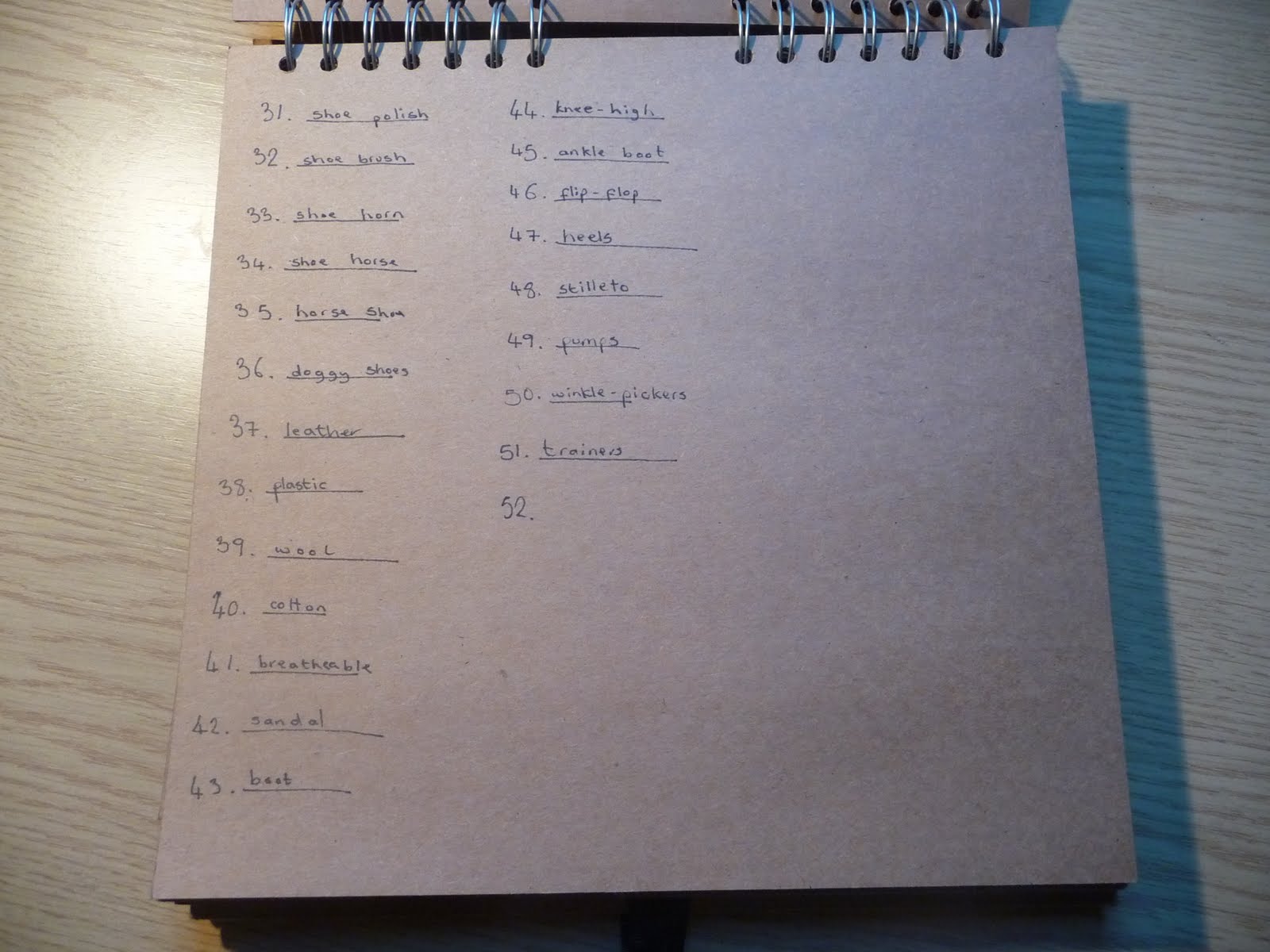
100 facts, 100 opinions, 100 objects...ABOUT SHOES

100 facts:


100 objects:


100 opinions:


Presentation of christmas research:
Subject matter: Shoes
Themes of research within subject matter: Style, popularity, purpose, history.
Themes to be developed: Purposes of shoes, persona created by shoes, history of the shoe, shoe styles.
Issues raised: More visuals.
Methods for categorising research: style, fastenings, brand, identity, materials.
Additional research required: What shoes say about people, dog shoes, foot prints, fashion of shoes now and through the past 100 years, re-occurring fashions.
Action to be taken: Look at taking information from a more specific area in shoes.






Final development and Final idea : Advertisement for new shoe brand launch. This will include a mini chocolate shoe inside a mini shoe box with information leaflet about the new brand and were it will be being launched and sold. Gift to be given out at a launch event.


Looking at shoes in their place of sale online and on shops.


Photo shoot for shoe box and leaflet.


Experiment with ribbon to fasten the gift box.


Chocolate shoes being made and packing of the 100 shoes.


Leaflet design ideas.


Final product.


Crit - feedback:
Issues raised: Why is there 100 shoes, is it limited edition? 100 first customers could get the shoes, is every box different, for example a different colour bow on each shoe box, numbered boxes? tissue inside box to make look nice. Chocolate market is always luxurious.
Action to be taken: Clarify content in categories and quantities. Test different ideas out for shoe packaging and chocolate packaging, look at existing companies, hotel chocolat and harvey nichols.


Final presentation crit feedback:
Is there and evening event for the shoes to be given out at? - Yes it will be given out at a launch event.
Lose the photographs of the shoes and legs and keep it clean cut.
Exclusive event with vip ticket only, have to pay for event ticket? Event tickets will be for respected customers and other retailers that will potentially buy these shoes at stock for their store.
Brand to same corporate identity as Harvey Nichols? Launching in a luxury store such as Harvey Nichols will give the brand a high class reputation. Maybe if it actually went into production I would have to change the final product to include the Harvey Nichols logo and company typeface.


Photography Elective

Brief:
Produce a set of photographic prints which represents the theme ' A SENSE OF PLACE'


PHOTOGRAPHY ELECTIVE,

A SENSE OF PLACE

EVALUATION


For this project I started off by looking at the brief title ‘A Sense of Place’ literally and by taking photos of the environment, scenery and buildings and how they are the place themselves. I visited Amsterdam and whilst there I took images of famous landmarks, traditional items related to that culture; clogs and bikes were the two most prominent. These items then created the ‘sense of place’.


I also went home to York and looked at a sense of place within the ancient city walls. I photographed in churches as well, which I think created a very good sense of place and you can almost feel the calming atmosphere inside a church within the images. I started looking at depth of field as well, and looking at how blurring out sections of the photographs (objects far or close to the lens) this could completely change what is being shown and portrayed in the images.


Not being great at remembering all the settings and controls on cameras I decided to mainly use automatic settings. Changing them just in the surroundings, for example, using the landscape setting outdoors would automatically set it to a small aperture and a large depth of field, ensuring that everything was in focus and also enhancing greens and blues.


After looking at the more structural and atmospheric side I decided to focus more emotionally on the ‘sense of place’ and how, not taking the briefings wording so literally. I looked at the sense of place within a person. Looking at existing photographers helped me understand how emotion can be portrayed through a photograph. I researched Oliver Vander Heyden, a fashion photographer who liked his work to show a story though the use of emotion, set, and great lighting. His work is very fake and, like the fashion business, made to look beautiful. I don’t really like the idea of knowing that the emotion is fake.


I also stumbled across a website called ‘Phatz Photography’ who, among a wide range of projects, have a large set of raw emotional photos. Real emotion as it happens, which I think creates a much more enjoyable image and an all round more interesting and believable image. This work I have interpreted by trying to capture raw emotion giving the images depth.


The work of Inez Van Lamsweerde intrigued and inspired me the most and in particular their collection ‘ expose bodies yet hide true feelings’. This work showed images of naked bodies where the subject had covered their face with their hands. Faces are painted on their hands expressing artificial emotions. I find it is a weird mix of styles, looking at the openness of how they are exposing their bodies and on the other hand suppressing their true emotions behind their hands. Why are they so free to expose their bodies, which is seen as very daring, yet hide their face, the focal point of all emotion?


I wanted to recreate an image of questionable emotion. Making people question weather the emotion is real or fake for the camera. Photographers such as, Joseph Nicephore Niepce and Frances Frith used to be thought of as an ‘invisible eye’ capturing events exactly as they happened and recording the truth. However photography can distort reality and document a moment in time never to be captured again with the potential to be absolutely fake.


The images a took I wanted to be portrait like from a passport photograph and so I chose a plain white background and plain clothing. I used the portrait setting on the camera which would give a wide aperture, focus on the foreground and enhance skin tones.


For my final piece ‘sense of place’ I have decided to focus on one persons emotions. Inspired from Inez Van Lamsweerde I want to pose the question, ‘Is emotion real?’ and create a sense of knowledge of the place in that persons life. I chose to photograph portraits of a friend Simon because I though he would feel at ease and project real emotions, but also these could be overshadowed by the fact there is a camera in front of him; enhancing the meaning of the final piece, weather his emotions are real or not, and capturing his place in time. My final piece was landscape. I chose to do this because I thought it would be visually more stimulating as the eye reads across. I am happy with my final piece. It captures what I wished to capture; emotions huddled together posing questions of truth and place in someone life.


Final image


Design Process - Software Workshop Photoshop

The brief was to produce a set of ten double-sided A6 postcards that explore the colour RED using PDF presentation. The postcards must exist as part of a set or series. Here is what I came up with... I wanted to keep things simple avoiding cliche photoshop tools so I just decided to focus on faming of the images using a lot of zoom and tweaking the brightness, contrast, saturation.


Visual Language - Photography Workshop


The brief was to produce a set of 10 photographic prints that explore the colour RED considering lighting, frame, format and its relationship with other colours. Here is my result:

Visual Language book making and book binding

We had lessons on different ways to make books and how to bind them. Here are the results:


We used string, tread and a hand drill to tie these pages together.


To make the holes for the thread to go through we used a hand drill lining up the pages together very precisely.


This pamphlet style book was folded using a special machine. To create the hard back cover we glued card to material (2x squares of card and a strip in the middle) wrapping the sides round to create a finished look.


These books are all simple folds and can only create 4 paged books, however these sections could be glued or sewn together to create a bigger book.


In this visual language lesson we all brought in a book and had to manipulate it in a certain way relating to the subject of the book. Mine was about English, so I decided to use the words throughout the book and create my own story. I cut out the vast majority of the book only leaving the amount of words that would fit a page. The story doesn't necessarily make sense and just shows how confusing language can be. I think the end result looks quite cute and I like the aesthetics of the fading yellow pages, which were actually very brittle and hard to work with.


Before we were set to work we were shown artists who work with books who had some amazing work and craftsmanship.

Brian Dettmer


Cara Barer


END OF MODULE SELF-EVALUATION

1. What skills have you developed through this module and how effectively do you think you have applied them?

I think I have learnt how to time keep better this module, increasingly more so towards the end and with the 'collection 100' product part. I didn't think I found it hard working in groups, but I seem to have found where I fall down. Communication within group work is vital and no matter what methods we attempted they didn't seem to embrace the whole group. In this sense I think i have developed survival skills, in that you do your best with what you have to work with and everything seems to pull together in the end one way or another.

Having chosen a subject which interested me for the 'collection 100' project I found myself much more engaged and wanting to get my head down and work. By choosing a subject I enjoy I found interesting research because I wanted to learn more about it. In previous projects I have normally started off with a subject that interests me but then decided to go somewhere completely different which doesn't interest me so much, I'm not quite sure why but it always seems to happen; so for this project I tried to stay as focused on 'me' as possible to create a final outcome which used my full potential.

I thought long and hard and decided reasonably quickly what I wanted to create and realising the huge work load I had set my self I think I panicked slightly which put me into turbo work mode to collect all the materials I would need and research more thoroughly what I wanted to achieve. After this brief panic I realised I had enough time to manufacture these chocolate shoes with precision and passion and not in a mad rush, making my time management at its best.

2. What approaches to/methods of research have you developed and how have they informed your design development process?

I have been a lot more hands on in this project, because it is mainly research based you have to get out there and see the issues for yourself and not just put yourself in a cocoon of ideas which may or may not be true. Approaching the target audience and going out and recording the issue in hand for the 'what if' project made our design decision much more informed ad valid. For the 'collection 100' project I tried to look at every aspect I could think to do with shoes. I went out to Leeds main shopping street to tally types, styles colours, etc of shoes people were wearing, interviews with cobblers and shop sales persons, photographs of shoes in their advertising environment, the history of the shoe etc. Getting a wide range of information helped me decide what my next step would be for the project.

3. What strengths can you identify in your work and how have/will you capitalise on these?

I think precision and detail are two of the main things I enjoy focusing on in work. Crafty and fiddly things interest and encourage me. Seeing a clear path of what I have to create and where I have to get helps me plan and work to my best ability. Although research can be somewhat tedious it is in the long run the backbone for every project so I will ensure to thoroughly research every project to come.

4. What weaknesses can you identify in your work an how will you address these more fully?

I think one of my main weaknesses is finding an idea that I like and not wanting to change it once I have it. Obviously with short time scales fast paced thinking is necessary but looking into other ideas could improve my final outcome. I can sit and think about what I want to do but I wont write down idea which I have though of and scrapped, I should write them down as evidence.

5. Identify five things you will do differently next time and what do you expect to gain from doing these?

1. Experiment with more ideas before I stick with one to carry through.
2. Work on presentation skills for my work to give a clearer projection of my idea.
3. Assign individual roles when working in a group.
4. Think about costs of an idea and practicality of producing it.
5. Look at more resources such as books to get inspiration.

If I do all of these and work to my full potential my work should be of the highest standard.

6. Grading...

Attendance: Very good
Punctuality: Excellent
Motivation: Excellent
Commitment: Excellent
Quantity of work produced: Excellent
Quality of work produced: Very good
Contribution to the group: Good